On this page
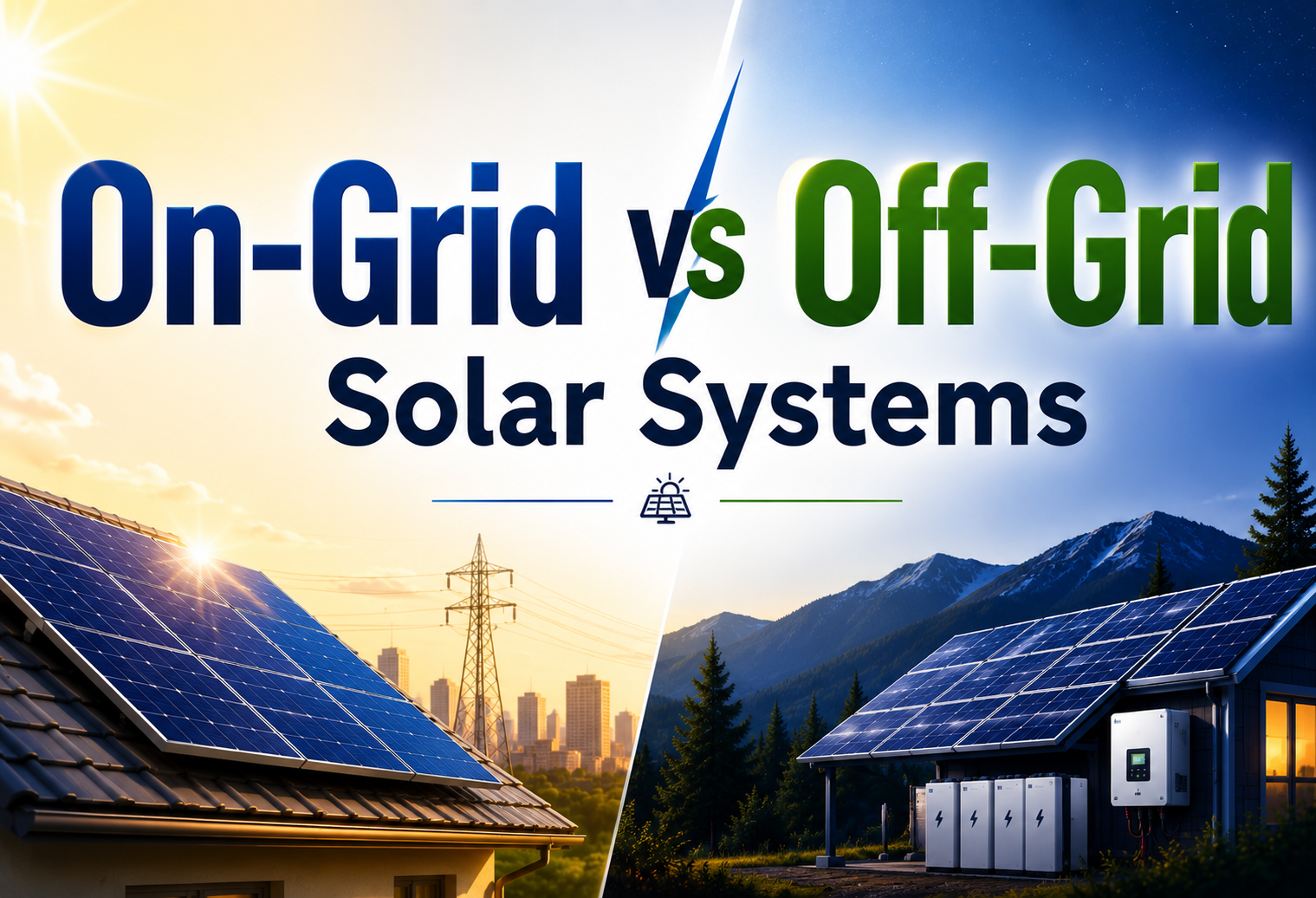
The difference comes down to one question: is your system connected to the grid, or does it run on batteries alone? That choice decides what you pay, whether you get the subsidy, what happens in a power cut and how much upkeep the system needs. Here is how each one works, where a hybrid fits in, and which suits a home like yours.
- The subsidy is for
- on-grid and grid-connected hybrid systems
- Off-grid systems get
- no subsidy and no net metering
- On-grid in a power cut
- switches off until the grid returns
- Lithium battery storage
- about ₹18,000 to ₹22,000 per kWh
The short answer
If your home has a reliable grid connection, as most homes in Hyderabad and Delhi do, an on-grid system is almost always the right choice. It costs the least, it gets the subsidy and it cuts your bill the most.
Off-grid makes sense where there is no grid, or where it's so unreliable that you can't count on it, such as a farmhouse or a remote site. A hybrid sits between the two, for homes that want lower bills and backup during power cuts.
How an on-grid system works
An on-grid system is connected to your DISCOM's lines through a net meter. In the day, your home uses the solar power first. Any extra goes to the grid, and the net meter counts it. At night and on cloudy days, you draw from the grid as usual, and the units you sent out earlier are set against it.
- Lowest cost. No batteries, so a 3 kW system is roughly ₹1.65 to ₹2.10 lakh before the subsidy.
- Gets the subsidy of up to ₹78,000 under PM Surya Ghar, and net metering.
- Little upkeep. Clean the panels, and expect to replace the inverter once in the system's life.
Many homes keep their existing inverter and battery for cuts, alongside on-grid solar. Our guide to what solar saves on your bill shows what an on-grid system takes off a typical bill.
How an off-grid system works
An off-grid system isn't connected to the grid at all. The panels charge a bank of batteries in the day, and your home runs from the batteries, day and night.
That means the system has to be sized for your worst days, not your average ones: enough panels to charge the batteries on cloudy monsoon days, and enough batteries to see you through the night and a day or two without much sun.
- It works where there is no grid, and keeps running through any power cut.
- The batteries make it much more expensive, and they need replacing during the system's life.
- There is no subsidy and no net metering, so surplus power on sunny days is simply lost.
- Heavy loads, such as air conditioners, geysers and motors, need a much bigger and costlier system.
Hybrid: the middle way
A hybrid system is connected to the grid like an on-grid one, but has a hybrid inverter and batteries. In the day, the panels power your home, charge the batteries and send any extra to the grid. In a power cut, the batteries take over the circuits you've chosen to back up.
- It cuts your bill like an on-grid system, and gives you backup in cuts.
- Being grid-connected, it can generally get net metering and the subsidy, as long as it meets the scheme's rules. The subsidy is worked out on the panels, so the batteries are at your own cost.
- It costs more than on-grid because of the batteries and the hybrid inverter, but less than a full off-grid system, because the batteries only need to cover cuts, not every night.
The three side by side
On-grid
- Batteries
- None
- In a power cut
- Switches off
- Subsidy and net metering
- Yes
- Cost
- Lowest
- Best for
- Homes with a reliable grid that want the biggest cut in their bill
Hybrid
- Batteries
- Enough to cover power cuts
- In a power cut
- Keeps the backed-up circuits running
- Subsidy and net metering
- Generally yes, on the panels
- Cost
- Middle
- Best for
- Homes with regular cuts, or work that can't stop when the power does
Off-grid
- Batteries
- Enough for every night and cloudy days
- In a power cut
- Not affected
- Subsidy and net metering
- No
- Cost
- Highest
- Best for
- Farmhouses and sites with no grid, or a grid you can't rely on at all
If you need batteries
Batteries are the biggest extra cost in a hybrid or off-grid system, so it's worth choosing them carefully.
Lithium (LiFePO4)
Costs about ₹18,000 to ₹22,000 per kWh of storage installed. It can be used down to most of its capacity, needs no maintenance and usually lasts around 8 to 12 years with daily use. Most new hybrid systems use lithium.
Lead-acid and tubular
Costs roughly half as much per kWh upfront. Only about half its capacity should be used, it wears out sooner, especially when emptied every day, and flooded types need topping up with distilled water. Over the life of the system, it often ends up costing more than lithium.
Size the batteries for what you actually need to run in a cut: a few lights, fans, the fridge and the Wi-Fi need far less storage than the whole house.
Which suits your home
- Cuts are rare and short
- On-grid. If you already have a home inverter and battery, keep it for the odd cut.
- Cuts are regular, or you work from home
- Hybrid, with batteries sized for the circuits you can't do without.
- There is no grid, or it can't be relied on
- Off-grid, sized for the cloudiest weeks of the year.
- You want the lowest bill for the money
- On-grid, which gives the biggest saving for each rupee spent.
Whichever you choose, the same basics apply: good panels, a proper structure and safe wiring. Our guide to mistakes to avoid before installing solar covers them.
How we help
We'll recommend the system that suits how you use power, not the one that costs the most.
- A free site survey, and an honest look at how often your power actually goes
- A system sized to your bills, with batteries only where they're worth it
- Help with the subsidy and net metering for on-grid and hybrid systems
- Installation by our own team, then after-sales service and panel cleaning
Not sure which one you need?
Tell us how often your power goes and what you'd want to keep running. We'll tell you plainly whether batteries are worth it for your home.
Questions people ask
Why does an on-grid system switch off in a power cut, even in full sun?
For safety. When the grid is down, line workers may be repairing it, and a rooftop system sending power into the lines could injure them. So on-grid inverters are built to stop the moment the grid goes off, and start again when it returns.
Can I keep my existing home inverter and battery?
Yes. Your inverter and battery keep working as backup for power cuts, exactly as they do now, alongside an on-grid solar system. In the day, the grid power that charges them is partly your own solar power.
Can I add batteries to an on-grid system later?
Usually, yes, by changing to a hybrid inverter or adding a battery system made to work with your existing inverter. If you think you might want batteries later, say so before you install, so the inverter can be chosen with that in mind.
Will an off-grid system run my air conditioner?
It can, but it needs many more panels and a large battery bank, which makes it very expensive. Off-grid systems are usually designed for lights, fans, a fridge and a pump, with heavy loads kept to sunny hours.
Does a hybrid system get net metering and the subsidy?
A hybrid system stays connected to the grid, so it can generally get net metering and the PM Surya Ghar subsidy, as long as it meets the scheme's rules and your DISCOM approves it. The subsidy is worked out on the panels, so the batteries are at your own cost.
How long do solar batteries last?
Lithium batteries usually last around 8 to 12 years with daily use. Lead-acid and tubular batteries are cheaper but wear out sooner, especially when emptied deeply every day, and flooded types need topping up with distilled water.